Guide
How Much Do Police Officers Make? Starting and Top Pay
Published
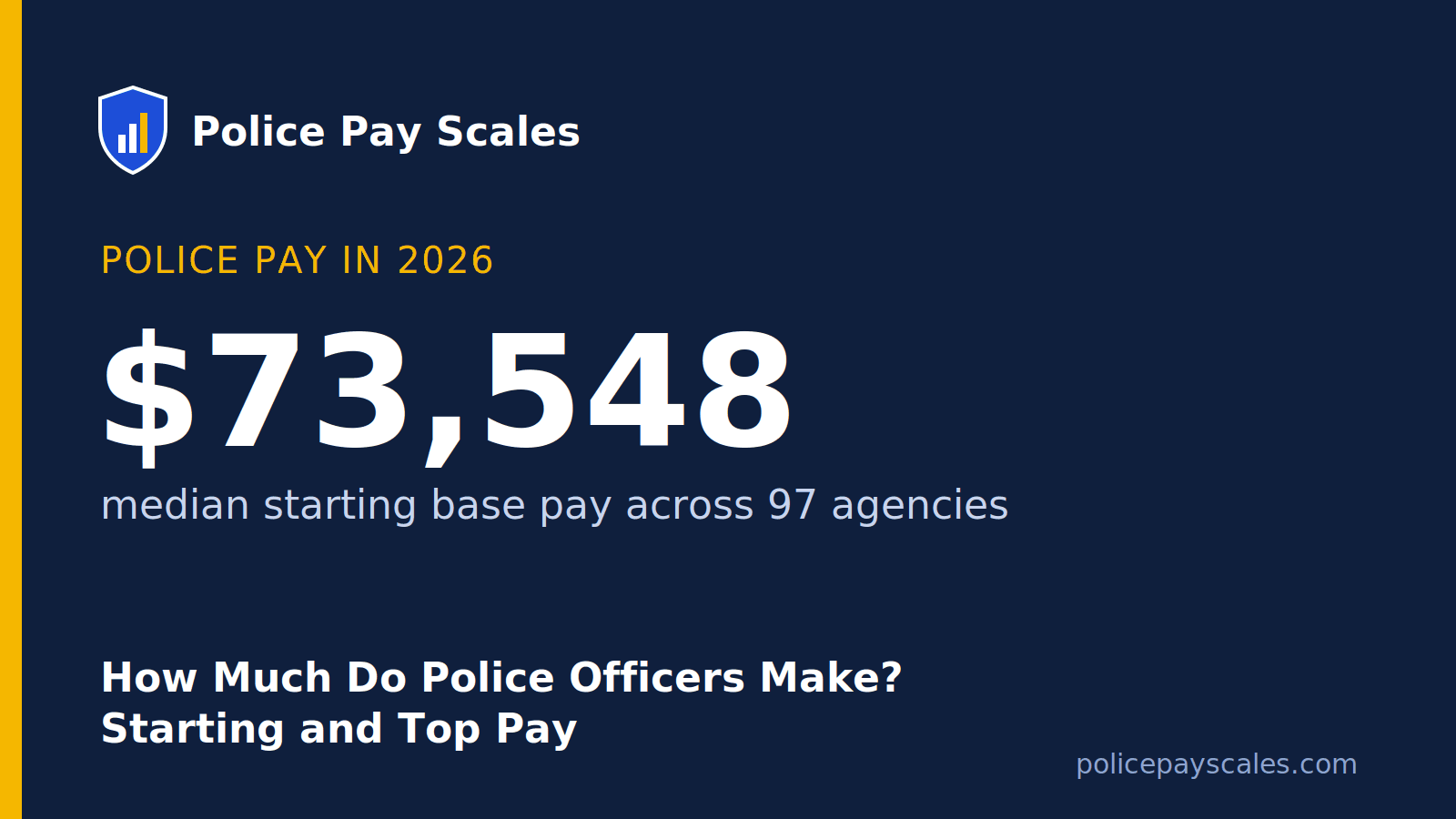
A new police officer in the United States earns a median starting base salary of $73,548, based on official pay schedules from 97 police departments, sheriff’s offices and state agencies. The range is wide: San Francisco Police Department in California starts officers at $121,654, while Detroit Police Department in Michigan starts at $45,760.
Pay climbs with service. The median top-step base salary is $109,340 across 78 agencies, and the typical officer schedule rises about 40% from the first step to the last.
Starting pay and top-step pay at a glance
Most agencies publish a step schedule, so two numbers matter: what you earn on day one and what you earn once you reach the final step. The highest top step belongs to Irvine Police Department at $171,309.
| Agency type | Median start | Median top step | Agencies |
|---|---|---|---|
| City and county police | $75,433 | $112,936 | 55 |
| State police and highway patrol | $70,222 | $105,273 | 42 |
| All agencies | $73,548 | $109,340 | 97 |
Median starting police pay by state
- Under $60k
- $60–70k
- $70–80k
- $80–90k
- $90k+
- Not yet verified
View chart data
| State | Amount |
|---|---|
| Maine | $65,166 |
| Wisconsin | $75,462 |
| Vermont | $84,160 |
| New Hampshire | Not published |
| Washington | $104,562 |
| Idaho | $62,546 |
| Montana | Not published |
| North Dakota | $75,528 |
| Minnesota | $86,588 |
| Illinois | $77,232 |
| Michigan | $58,604 |
| New York | $58,580 |
| Massachusetts | $80,213 |
| Rhode Island | Not published |
| Oregon | $80,559 |
| Nevada | $74,247 |
| Wyoming | $68,619 |
| South Dakota | Not published |
| Iowa | $71,406 |
| Indiana | $70,000 |
| Ohio | $73,774 |
| Pennsylvania | $69,973 |
| New Jersey | $77,143 |
| Connecticut | $76,625 |
| California | $97,635 |
| Utah | $75,878 |
| Colorado | $81,046 |
| Nebraska | $72,382 |
| Missouri | $73,824 |
| Kentucky | $64,998 |
| West Virginia | $62,778 |
| Virginia | $61,917 |
| Maryland | $68,860 |
| Delaware | $91,265 |
| Arizona | $72,250 |
| New Mexico | $79,248 |
| Kansas | $69,922 |
| Arkansas | $67,675 |
| Tennessee | $68,940 |
| North Carolina | $62,338 |
| South Carolina | $62,854 |
| District of Columbia | $75,433 |
| Oklahoma | $65,987 |
| Louisiana | $56,051 |
| Mississippi | Not published |
| Alabama | $46,469 |
| Georgia | $62,336 |
| Hawaii | $68,658 |
| Alaska | $91,385 |
| Texas | $78,358 |
| Florida | $71,892 |
What base pay leaves out
Base pay is only part of an officer’s paycheck. Overtime, shift differentials, longevity steps, college-degree pay and bilingual pay can add thousands a year, and those extras vary more between agencies than base pay does.
For a wider view, the federal Bureau of Labor Statistics surveys every agency in each state. Those estimates appear on each state page in a separate box, because they mix all experience levels and cannot be compared step for step with a department schedule.
Find a department
Each state page compares its departments side by side. Start with the states that have the most agencies published: California, Texas, Arizona, Colorado, Florida.
Figures come from the official pay schedules linked on each state and department page. Agencies revise pay plans, so confirm the fiscal year and step rules with the official source before you rely on a number.